Home 600,000 Miles Organic Acid Technology Fleet Tested and Proven Save Time & Money Frequently Asked Questions Request More Info Final Charge Final Charge 50/50 Final Charge Extender Final Charge Converter Links

Questions 
(the frequently asked kind)

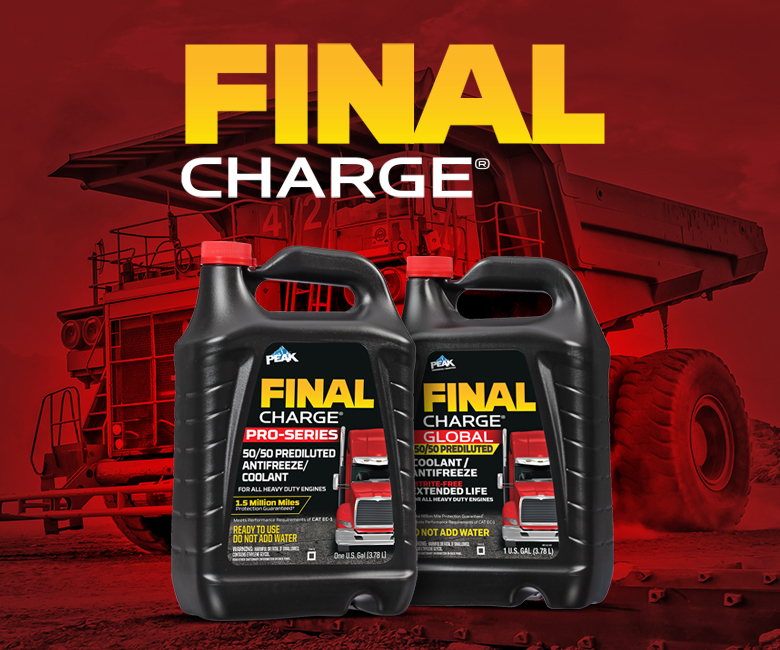
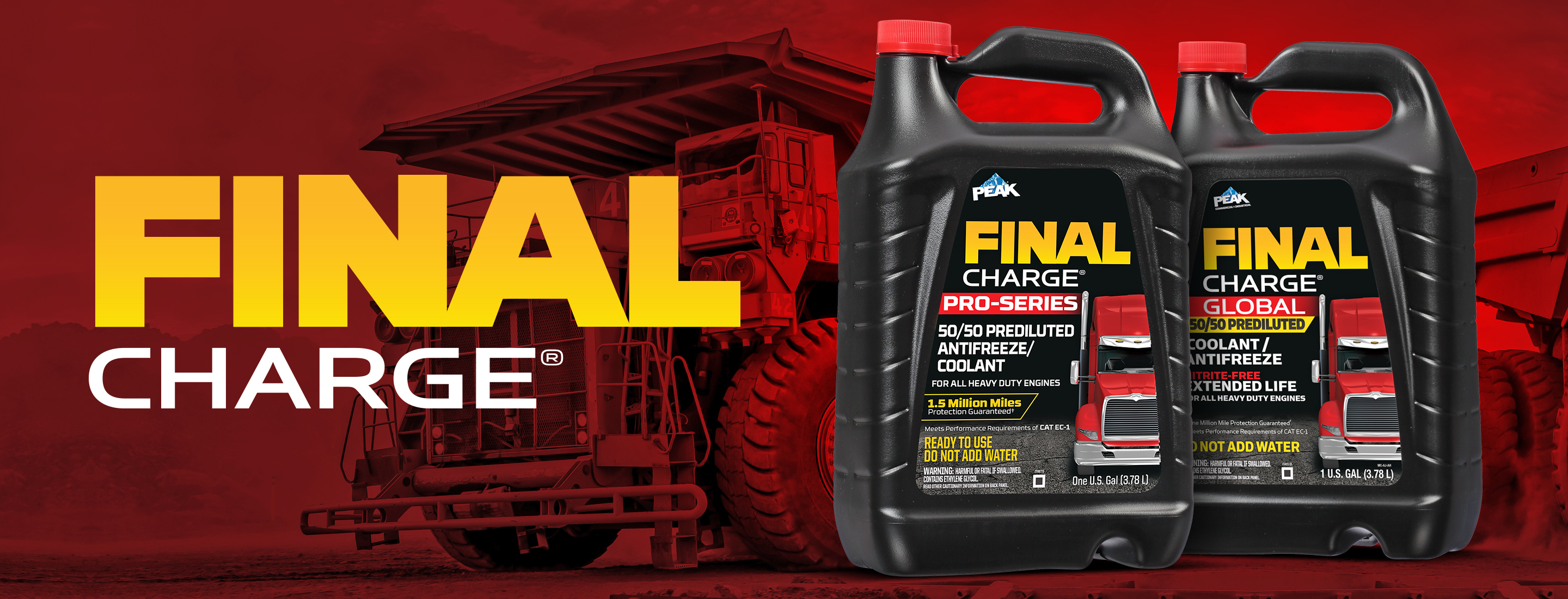
FINAL CHARGE® GLOBAL EXTENDED LIFE COOLANT/ANTIFREEZE Q&A

1. What is FINAL CHARGE Coolant?
2. Is FINAL CHARGE Coolant new to the market?
3. Why are trucks being factory filled with extended life coolant?
4. I've heard of extended life coolants. Who is using them and why?
5. Do extended life coolants have "acids" in them? Does "acid based" mean it is corrosive?
6. Does FINAL CHARGE Coolant meet Cat EC-1 requirements?
7. Besides Cat EC-1, what other OEM Specifications does FINAL CHARGE Coolant meet?
8. What ASTM and TMC specifications does FINAL CHARGE Coolant meet?
9. The industry seems to be moving away from nitrites - What is the nitrite content in FINAL CHARGE Coolant?
10. Is FINAL CHARGE Coolant a low silicate, phosphate-free coolant?
11. Today's engines generate more heat than ever before. Will this affect the performance of FINAL CHARGE coolant?
12. Does FINAL CHARGE Coolant protect seals and gaskets against wear and corrosion?
13. Do I need to test for SCA or nitrite levels?
14. Should I continue to use a chemically charged coolant filter after converting to FINAL CHARGE Coolant?
15. If I do not need to add SCAs or use chemically charged filters, how do I determine the amount of FINAL CHARGE Extender to add and when? Is the use of coolant test strips needed?
16. My truck is filled with FINAL CHARGE Coolant and I know a conventional coolant was added at top off. Will this affect the coolant performance?
17. My truck is using a conventional coolant, and I would like to change to FINAL CHARGE Coolant. How do I convert my truck?
18. My truck is using a heavy-duty OAT coolant, but I would like to change to FINAL CHARGE Coolant. How do I convert my truck?
19. Do I have to use special water to mix with FINAL CHARGE Coolant?
20. What are the recommended maintenance procedures for a truck using FINAL CHARGE Coolant?


1.What is FINAL CHARGE Coolant?

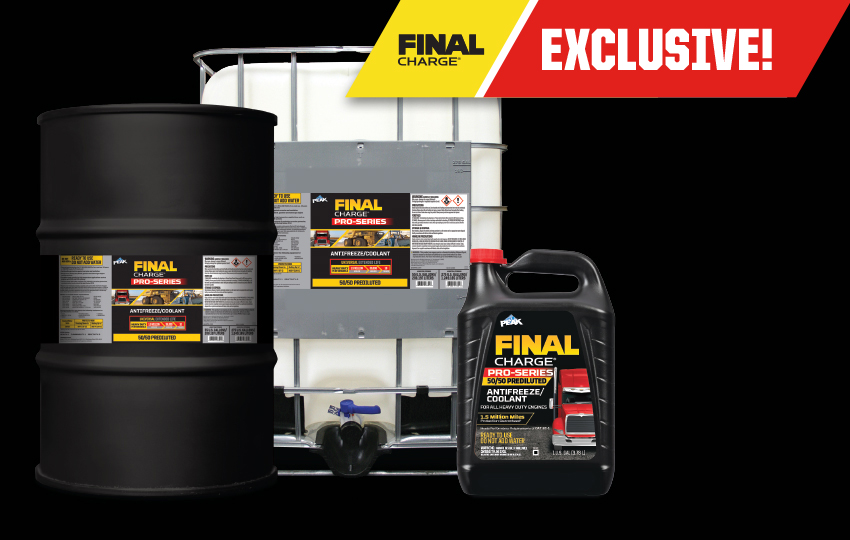
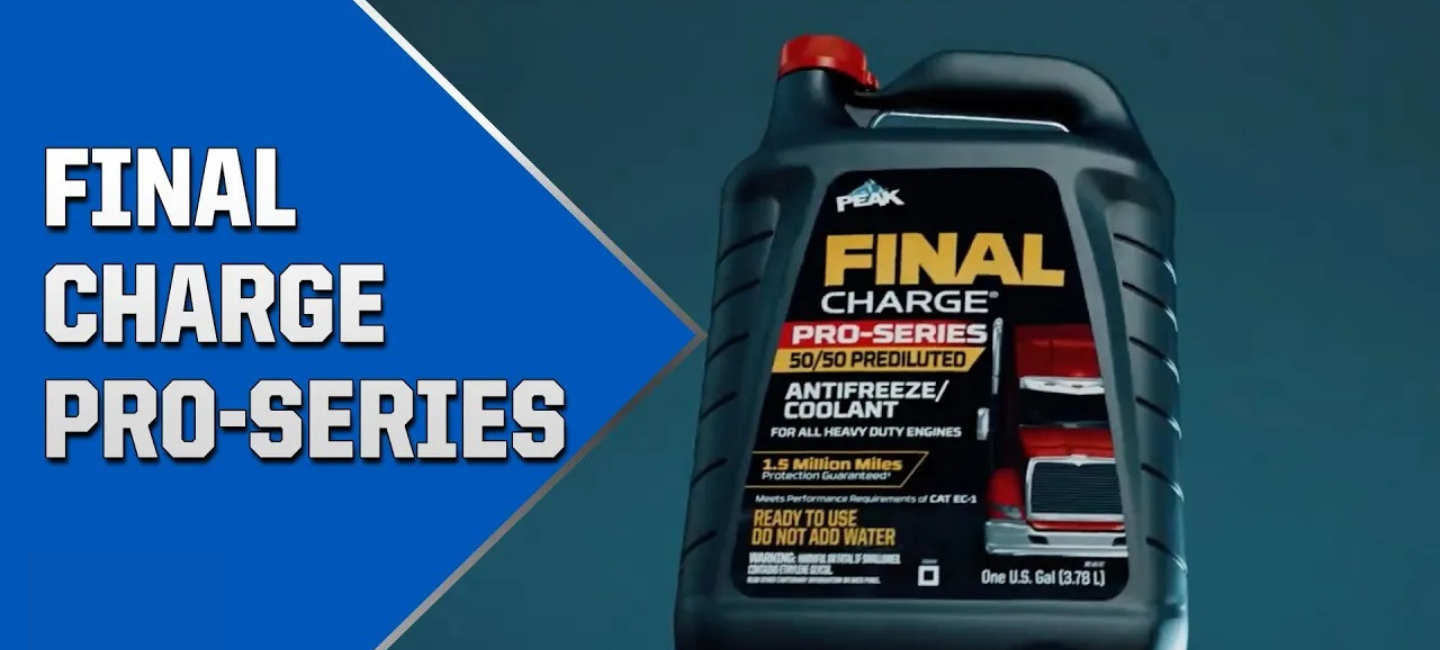
FINAL CHARGE Coolant is a heavy-duty extended life coolant that provides total cooling system protection for 600,000 miles of on-road use (6 years or 12,000 hours of off-highway use) with the addition of a FINAL CHARGE Extender at 300,000 to 400,000 miles of on-road use (3 years or 6,000 hours of off-highway use). FINAL CHARGE is based on Organic Acid Technology (OAT) and uses proprietary engine protecting inhibitors that do not deplete as quickly as conventional "old" technology coolant and SCA products.

back to top


2. Is FINAL CHARGE Coolant new to the market?

FINAL CHARGE Coolant's original technology was first used commercially in 1987. Since then, Final Charge Coolant's patented technology has been in service for over 10,000,000,000 service miles and, today, is marketed by leading international heavy-duty OEM's.

back to top


3. Why are trucks being factory filled with extended life coolant?

As engine and truck builders extend overall service intervals, factory fill products must be able to reach the extended service goals. Some truck manufacturers are filling new engines with extended life coolants to offer their customers the highest coolant performance, extended coolant service intervals and reduced overall maintenance costs.

back to top


4. I've heard of extended life coolants. Who is using them and why?

Today, all leading heavy-duty OEMs, including Caterpillar and Freightliner, offer extended life coolant as a factory fill coolant. Extended life coolants offer the lowest cost of ownership through longer coolant life, longer coolant change intervals, and the elimination of SCAs and routine inhibitor testing.

back to top


5. Do extended life coolants have "acids" in them? Does "acid based" mean it is corrosive?

The organic acids in FINAL CHARGE Coolants patented formula have been neutralized to form highly effective corrosion inhibitors. The difference is that they are neutralized organic acids instead of the neutralized inorganic acids found in conventional heavy-duty coolants. Using neutralized acids as corrosion inhibitors in coolants is not new. Conventional coolants contain neutralized inorganic acids as inhibitors, such as phosphate and/or borate, which are derived from the neutralization of phosphoric acid and boric acid, respectively.

back to top


6. Does FINAL CHARGE Coolant meet Cat EC-1 requirements?

Fleet test in Caterpillar C-15 engines demonstrate that FINAL CHARGE coolant meets Cat EC-1 requirements. EC-1 is Caterpillar’s industry specification for an extended service coolant.

back to top


7. Bessides Cat EC-1, what other OEM Specifications does FINAL CHARGE Coolant meet?

FINAL CHARGE Coolant also meets Cummins 14603, Detroit Diesel, Mercedes DBL 7700 and MTU 5048 coolant specifications, and is recommended for use in all types of heavy-duty diesel gasoline and natural gas engines, making FINAL CHARGE Coolant ideal for use in mixed fleet applications.

back to top


8. What ASTM and TMC specifications does FINAL CHARGE Coolant meet?

FINAL CHARGE Coolant meets leading ASTM coolant specifications, including ASTM D-4985 and ASTM D-3306. However, it should be noted that ASTM has not established a specification for extended life coolants. Instead, current ASTM specifications are more geared toward conventional coolants that have a limited service life, typically 3-year/36,000 mile. As with ASTM, TMC has not set coolant specifications addressing extended life coolants. TMC RP-329, a long-standing heavy-duty coolant standard, is the specification for a conventional low silicate coolant that is precharged with a Supplemental Coolant Additive (SCA) containing nitrite or nitrite and molybdate. While FINAL CHARGE Coolant definitely meets the performance requirements of TMC RP-329, it does not meet the chemical requirements of the specification. 

The reason FINAL CHARGE Coolant does not meet the chemical requirements of TMC RP-329 is that FINAL CHARGE Coolant’s proprietary corrosion inhibitor system does not contain nitrite. With FINAL CHARGE Coolant, nitrites, and other conventional inhibitors like phosphate and silicate, are replaced with longer lasting organic corrosion inhibitors to provide total cooling system protection. At the end of the day, it’s about coolant performance, not specific chemistry.

back to top


9. The Industry seems to be moving away from nitrites - What is the nitrite content in FINAL CHARGE Coolant?

Nitrites have long been used in fully formulated coolants, or incorporated in Supplemental Coolant Additive (SCA) then mixed with conventional coolants, for their ability to protect wet sleeve liners against cavitation and corrosion. However, nitrites in conventional and fully formulated coolants deplete, thereby reducing the level of protection provided. Also, ongoing testing and monitoring of nitrite levels are required to ensure the proper levels are maintained.

To extend coolant service life and reduce maintenance time and cost associated with testing and maintaining inhibitor levels, the heavy-duty industry is moving toward nitrite-free Organic Acid Technology (OAT) coolants. With OAT coolants, conventional inhibitors, like nitrites, are replaced with organic corrosion inhibitors that deplete very slowly over time. As a result, extended life corrosion and cavitation protection is achieved without a regular schedule of liquid additives, inhibitor testing and maintenance coolant filters. FINAL CHARGE Coolant is formulated with a patented nitrite-free formula.

back to top


10 . Is FINAL CHARGE Collant a low silicate, phosphate-free coolant?

FINAL CHARGE Coolant is silicate-free. Instead of using silicates, the advanced formula contains corrosion inhibitors called organic acids. FINAL CHARGE Coolant is also phosphate-free, nitrite-free and borate-free. The patented OAT inhibitor system provides excellent overall corrosion protection while reducing dropout, water pump seal damage, and internal cooling system scaling and storage stability often associated with conventional coolants.

back to top


11. Today's engines generate more heat than ever before. Will this affect the performance of FINAL CHARGE Coolant?

Compared to the inhibitors used in conventional coolants, FINAL CHARGE Coolant forms a thinner, longer lasting film on engine metals that protects against cavitation and corrosion. The thinner film provides better heat transfer between the engine metals and the coolant. Furthermore, FINAL CHARGE Coolant is formulated with special proprietary stabilizers that slow down the degredation of glycol at high temperatures. This is especially important with the advent of EGR technology. The result, your engine can run cooler with FINAL CHARGE Coolant.

back to top


12. Does FINAL CHARGE Coolant protect seals and gaskets against wear and corrosion?

FINAL CHARGE Coolant’s patented silicate-free, phosphate-free, nitrite-free and borate-free formula provides outstanding long-term NBR, viton and especially silicon elastomer protection. And unlike other heavy-duty extended life coolant technologies, FINAL CHARGE Coolant does not require the addition of a separate bottle of silicate additive to prevent gasket degradation in the front cover and oil cooler header gaskets in International DT466 and 530 engines.

back to top


13. Do I need to test for SCA or nitrite levels?

No. FINAL CHARGE Coolant, which features a patented inhibitor system that is phosphate-free, silicate-free, nitrite-free and borate-free, reduces inhibitor drop out and eliminates the need for SCA's and routine testing of inhibitor levels. To maintain the protection of FINAL CHARGE Coolants proprietary inhibitor system, proper cooling system maintenance is required. This includes following the recommended maintenance procedures outlined in question #20.

back to top


14. Should I continue to use a chemically charged coolant filter after converting to FINAL CHARGE Coolant?

Most coolant filters contain SCAs and are not required when using FINAL CHARGE Coolant. Blank filters, which do not contain SCAs, should be used instead. Follow the manufacturer's recommendations if a blank filter is recommended for the cooling system.

back to top


15. If I do not need to add SCAs or use chemically charged filters, how do I determine the amount of FINAL CHARGE Extender to add and when? Is the use of coolant test strips needed?

In a cooling system using conventional coolant, the spin on filter element has a pre-determined amount of SCA to add to the system. The interval for the addition of the SCA is determined by the inhibitor depletion rate and the quantity needed is based on cooling system capacity. Test strips are used to monitor key inhibitor levels, like nitrites, in conventional coolants.

The amount of FINAL CHARGE Extender to add to the cooling system is also based on cooling system capacity. However, due to the extremely slow depletion rate of FINAL CHARGE Coolant's proprietary inhibitors, a single addition of FINAL CHARGE Extender is only needed at 300,000 to 400,000 miles of on-road use (3 years or 6,000 hours of off-highway use) and routine testing of inhibitor levels is eliminated. Extended life protection is achieved without a regular schedule of liquid additives, maintenance coolant filters or extended life filters. This feature alone can significantly reduce maintenance costs.

back to top


16. My truck is filled with FINAL CHARGE Coolant and I know a conventional coolant was added at top off. Will this affect the coolant performance?

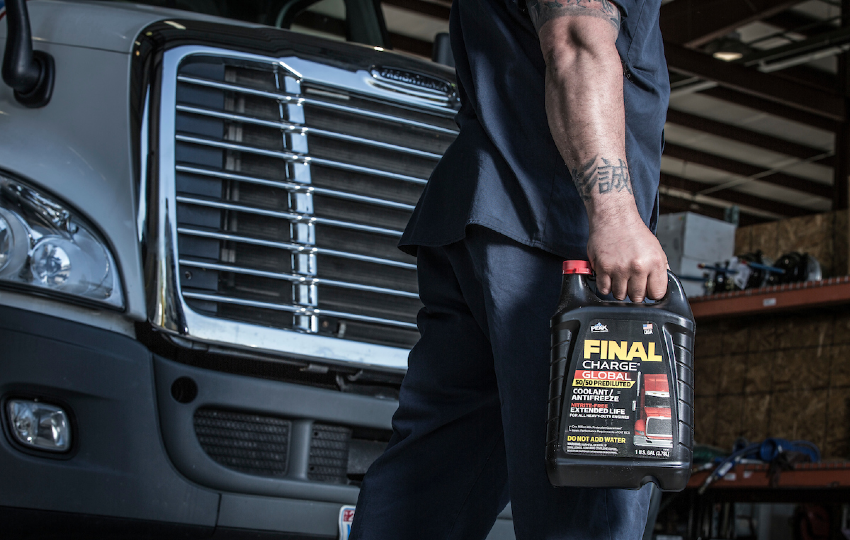
FINAL CHARGE Coolant is formulated with Contamination Tolerant Additives (CTAs). The performance benefits of FINAL CHARGE Coolant will not be adversely affected by the occasional addition of conventional coolants. However, it is recommended that effort be made to keep contamination levels below 25%. This can be accomplished by topping off with FINAL CHARGE 50/50 Pre-Diluted Global Extended Life Coolant and the periodic adjustment of the cooling system to maintain between a 45% to 60% coolant and a 55% to 40% water mix. 

back to top


17. My truck is using a conventional coolant, and I would like to change to FINAL CHARGE Coolant. How do I convert my truck?

With the FINAL CHARGE Global Extended Life Coolant Fleet Conversion Program, you can convert a truck using conventional or fully formulated coolants to FINAL CHARGE Coolant without having to drain, flush and refill the cooling system. At the center of this program is FINAL CHARGE Converter. FINAL CHARGE Converter is formulated with a special blend of FINAL CHARGE Coolant's patented Organic Acid Technology (OAT) inhibitors with Contamination Tolerant Additives. A one-time dose of FINAL CHARGE Converter is specifically formulated to convert properly maintained cooling systems using conventional or fully formulated coolants meeting ASTM D-4985, ASTM D-6210 or TMC RP-329 to FINAL CHARGE Coolant's patented formula. By converting to FINAL CHARGE, you should realize an additional 600,000 miles of on-road use (6 years or 12,000 hours of off-highway use) without the use of Supplemental Coolant Additives (SCAs), with the addition of FINAL CHARGE Extender at 300,000 to 400,000 miles of on-road use (3 years or 6,000 hours of off-road use), in a properly maintained cooling system. The amount of FINAL CHARGE Converter to add is based on the cooling system capacity.

back to top


18. My truck is using a heavy-duty OAT coolant, and I would like to change to FINAL CHARGE Coolant. How do I convert my truck?

With FINAL CHARGE Coolant's patented formula, you can convert a truck using a heavy-duty OAT coolant without having to drain, flush and refill the cooling system. For vehicles already using another brand of heavy-duty OAT coolant, simply begin and continue fulfilling all top off requirements with FINAL CHARGE Coolant. From the time when you started topping off the cooling system with FINAL CHARGE Coolant, you should realize an additional 600,000 miles of on-road use (6 years or 12,000 hours of off-highway use) without the use of Supplemental Coolant Additives (SCAs), with the addition of FINAL CHARGE Extender at 300,000 to 400,000 miles
of on-road use (3 years or 6,000 hours of off-road use), in a properly maintained cooling system. The addition of FINAL CHARGE Converter is not required.

back to top


19. Do I have to use special water to mix with FINAL CHARGE Coolant?

For optimum performance, deionized water should be used. In cases when deionized water is not available, FINAL CHARGE Coolant contains proprietary scale inhibitors allowing the coolant to be mixed with all water qualities without jeopordizing coolant performance or damaging engine metals. 

back to top


20. What are the recommended maintenance procedures for a truck using FINAL CHARGE Coolant?

To maintain the protection of FINAL CHARGE Coolant's patented technology, the proper level of the proprietary inhibitor system should be present in the cooling system. The inhibitor system used in FINAL CHARGE Coolant is formulated with Contamination Tolerant Additives and will not be adversely affected by the occasional addition of a non-organic acid coolant. However, it is recommended that contamination levels be kept below 25%. This can be accomplished by adhering to the following maintenance practices:

  • Use only FINAL CHARGE concentrate or FINAL CHARGE 50/50 Pre-Diluted Coolant when topping off the cooling system.

  • If FINAL CHARGE Coolant is not available, top-off the cooling system with water.

  • Maintain between a 45% to 60% coolant and a 55% to 40% water mix. 

  • Do not add Supplemental Coolant Additives (SCAs) to the cooling system or use chemically charged filters.

  • Add FINAL CHARGE Extender after approximately 300,000 to 400,000 miles of on-road use (3 years or 6,000 hours of off-road use).

back to top


Copyright 2001-07 Old World Industries, Inc. - All Rights Reserved.

Terms and Conditions